The starting point is simple: both workers and firms respond to incentives.
Alexander Willén

The NHH professor has been awarded an ERC Starting Grant worth more than NOK 16 million from the European Research Council.
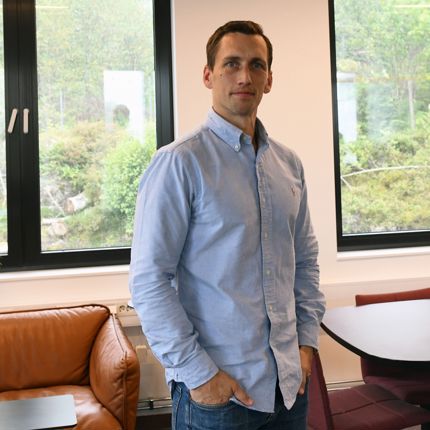
Now Alexander Willén will investigate how competition and the structure of labour markets shape the development of individuals, firms and regions – and what this means for productivity and economic inequality.
Willén is Professor at the Department of Economics and FAIR, the Centre of Excellence.
More than 4,800 researchers applied for this year’s ERC Starting Grants, where scientific excellence is the sole evaluation criterion. The grants are designed to enable outstanding early-career researchers to establish their own research programmes and pursue ambitious, ground-breaking projects.
A total of 421 researchers received funding. In other words, more than 90 per cent of the applicants were unsuccessful.
‘You never know how things will turn out in such a competitive call. There are an incredible number of strong researchers in this generation, and competition has become particularly intense in Europe. So I am extremely happy that the project has now been given this opportunity,’ says Willén.
Willén applied with the project Foundations: Labor Market Structure and the Foundations of Productivity. He will investigate how labour market competition affects workers’ skill development, firms’ choices and, ultimately, productivity.
‘We know that wages increase with experience, that regional differences persist, and that there are large productivity differences between firms. But we know much less about why these differences arise.’
According to Willén, economists still know too little about how productivity develops through the interaction between workers, firms and local labour markets.
‘What conditions make workers more productive? Why do highly productive firms cluster in some places while other areas fall behind? And what do firms do to develop and sustain productivity?’
The starting point is simple: both workers and firms respond to incentives.
Alexander Willén
In recent years, economists have become far more interested in competition and market power in labour markets. Much of this research has examined how workers’ outside options affect wages, mobility and employment, among other outcomes.

Willén wants to investigate a question we still know far less about: how competition affects the way productivity is created and develops over time.
‘The starting point is simple: both workers and firms respond to incentives, and competition in the labour market helps shape those incentives.’
‘If there is only one employer, or just a few employers, in an area, workers have few alternatives. If many firms compete for the same workers, employees have more options. The question is whether this also affects which firms people choose to work for, how much they learn and develop, and how firms organise and make use of their skills.’
The project will also examine how competition affects where firms choose to locate and how they organise work internally.
‘We still know surprisingly little about how these mechanisms interact and ultimately create productivity differences between workers, firms and regions.’
Willén is Professor of Economics at NHH and primarily conducts research in labour economics. His work has focused in particular on how institutions, market power and incentives affect workers and firms.
There are not many places where you find such strong research environments in both labour economics and behavioural economics under one roof.
Alexander Willén
His previous research has covered topics including trade unions, wage formation, labour market competition, education, and how workers are affected by major changes in the economy.
‘A recurring theme in much of my research is an interest in how the labour market actually works, and how the institutions around us shape the choices made by individuals and firms.’
Willén has developed the ideas behind the project over several years, but highlights the research environment at FAIR as important in challenging and further developing those ideas.
‘There are not many places where you find such strong research groups in both labour economics and behavioural economics in the same place. It creates a very particular intellectual dynamic. People are genuinely interested in each other’s research, and there is a culture of discussing ideas, challenging arguments and looking at the same questions from different perspectives. That has been extremely important for the development of the project.’