Bookmakers’ odds largely reflect public belief and sentiment.
Mario Guajardo

Norway has a 70 percent chance of advancing from the group stage, according to new mathematical calculations.
At long last, 28 years of waiting is over. In the early hours of Wednesday, June 17, Norway turns its eyes to the World Cup.
Expectations among the public have risen in step with positive reports from the training camp in North Carolina. A draw in a friendly against a strong Morocco side has hardly dampened the dream of Norwegian World Cup success.
So far, the tournament has been a ‘World Cup of surprises.’ Norway sits high on the odds lists, and many see Haaland, Ødegaard as outsiders in the competition. If Cape Verde can take points off Spain, why shouldn’t Norway go all the way?
Bookmakers’ odds largely reflect public belief and sentiment.
Mario Guajardo
Here is the verdict from the computers:
Mathematical calculations carried out at NHH show that Norway has a 70 percent chance of advancing from the group stage. But after that, the probabilities of progressing drop, according to Professor and mathematics expert Mario Guajardo.
Based on simulations of 100,000 World Cup outcomes, Norway has just a 20.75 percent chance of reaching the round of 16, and a 6 percent chance of making the quarter-finals. What about lifting the trophy at MetLife Stadium on July 19?
It may remain a dream.
According to the model, Norway has a 0.02 percent chance of winning the World Cup.
‘If the World Cup were played 5,000 times, Norway would statistically win it once,’ says Guajardo.
The simulations were carried out by master’s students Michel Dascaleac and Aodren Marianne as part of their master’s thesis in business analytics.
According to the model, France and Spain are the most likely winners, followed by Argentina and England. While Norway ranks in the top 10 on the odds lists, they are all the way down in 27th place on the probability ranking, behind countries such as Japan, Austria and Iran.
How is that possible?
27. Norway (0, 02)
The model largely captures historical performance, and not whether a team has stars like Haaland in peak form. Nor does it account for factors such as dressing-room tensions or psychological pressure, which can influence performances, Guajardo notes.
So is the model reliable? Yes, says the NHH professor. Not as a prediction of what will happen, but as an objective tool for understanding probability and risk.
‘Bookmakers’ odds largely reflect public belief and sentiment. The value of models lies in their objectivity. They provide probabilities based on data, free from human emotion and sentimental attachment to players,’ he says.

For supporters looking for hope: there’s always another match, and more than one way to calculate probabilities.
The researchers have also tested a model that focuses on attacking and defensive strength rather than historical rankings. Under this approach, the outlook suddenly looks much brighter for Norway.
In this model, Norway’s winning probability rises to 0.8 percent.
‘This captures the team’s current form and ability to score goals,’ explains Guajardo’s colleague, Professor Julio Goez, who teaches simulation modelling at NHH.
This model better reflects the impact of players like Haaland and Sørloth, who consistently score in the world’s top leagues.
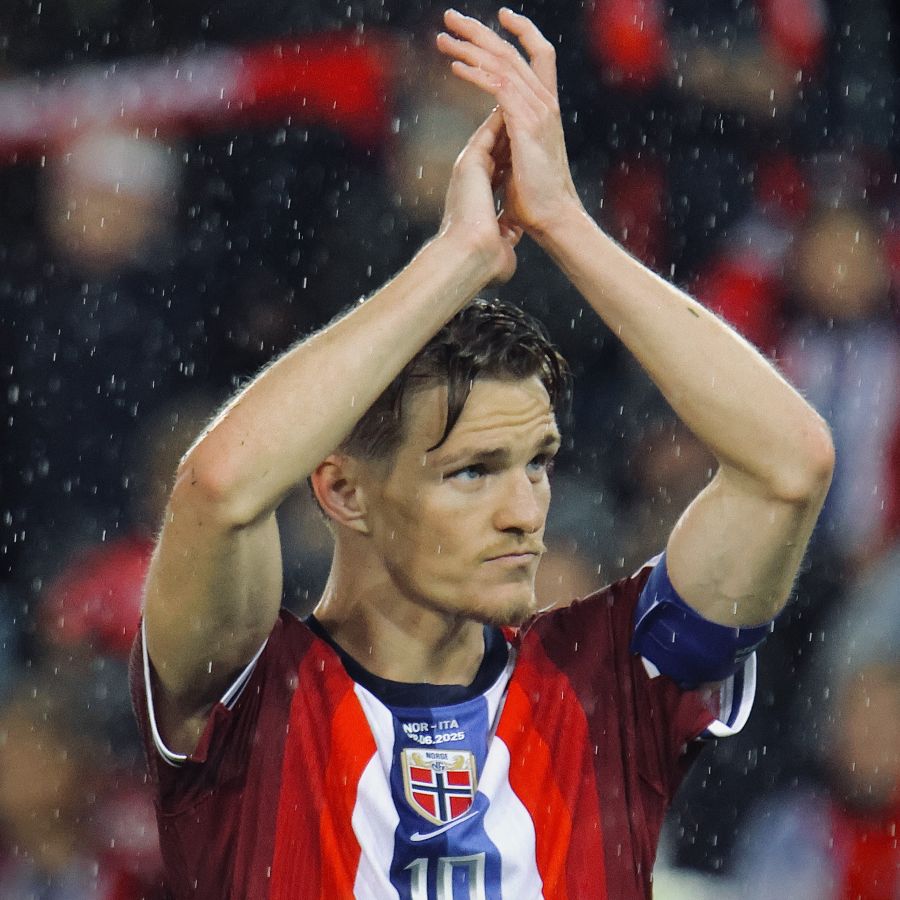
So who, or what, should we believe? According to Guajardo, there are dozens of different scientific approaches to estimating World Cup probabilities.
Ultimately, the researchers stress that football’s essence is unpredictability. While favourites tend to win in sports like basketball or chess, a single red card or a lucky corner can change everything in football.
‘No one has a crystal ball,’ they say.
Even if the model has run 100,000 simulations, the World Cup will only be played once in reality. And in that one tournament, anything can happen.
And even if France has a 20 percent chance of winning the World Cup, there is still an 80 percent chance they won’t.